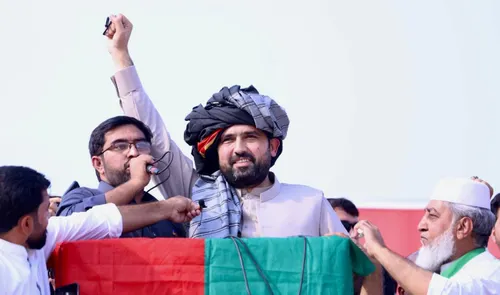
In the context of Pakistan’s current political situation and preparations for the proposed long march on September 27, the ‘street movement’ launched by Khyber Pakhtunkhwa’s Chief Minister Sohail Afridi has exposed several critical aspects of national politics and the role of leadership. The Chief Minister’s conduct, aimed at garnering public sympathy and mobilization for the September 27 protest, proved to be little more than cheap political theater and a disruptive stunt, rather than the behavior expected of a constitutional provincial head.
When comparing the political responses in Sindh and Punjab, the situation is exceptionally clear. In Sindh, the Pakistan Peoples Party leadership, particularly Asif Ali Zardari, demonstrated traditional diplomatic flexibility, offering some leniency and tolerance during Afridi’s visit. However, when this movement entered Punjab—and specifically the heart of Lahore—the public and their political consciousness completely rejected it, ignoring him entirely. By dismissing his negative narrative and divisive politics, the people of Lahore proved they are fed up with politics rooted in allegations and theatrics.
During his visit to Punjab, none of Sohail Afridi’s actions were befitting the dignified office of Chief Minister. His behavior mirrored that of an irresponsible agitator rather than a constitutional leader. At every turn, he relied on false allegations and acting in failed attempts to play the victim and stage his own “abduction.” The reality was that he voluntarily sat inside his vehicle while Punjab Police officials repeatedly pleaded with him to step out, yet he chose to drag out his performance. He not only severely compromised the Punjab Police’s security efforts but also needlessly wandered alone despite facing serious security threats.
The most dangerous and irresponsible element of his visit was his deliberate dismantling of the foolproof security protocols arranged for his safety. This attitude was not only an administrative disaster but a massive threat to Pakistan’s national security and unity. History bears witness that if, God forbid, the KPK Chief Minister had faced a security incident or attack on Punjab’s soil, the entirety of the blame would inevitably have been pinned on the Punjab government and administration. This was a direct conspiracy to fan the flames of provincialism and divide the country.
After witnessing the dismal fate of his street movement in Punjab and realizing his actual political worth, he has now resorted to cheap tactics and throwing tantrums. He is now acutely aware that rallying the public to take to the streets for the September 27 long march is no longer possible.
The fundamental reason behind this failure is the unparalleled, record-breaking developmental work of Punjab’s current Chief Minister, Maryam Nawaz. Thanks to her daily, outstanding services in public welfare, health, education, and infrastructure, the majority of Punjab now recognizes the practical performance of the Pakistan Muslim League (N). The public clearly sees the contrast: on one side is a leadership focused on sloganeering, drama, mischief, and gambling with national security; on the other is a model of development, public service, and serious governance. This is exactly why Punjab has permanently buried the politics of agitation and theatrics, placing its trust solely in the politics of performance.