From South Asia to the Gulf and Southeast Asia, Islamabad’s expanding partnerships signal a changing strategic landscape
By Roohi Khan
ISLAMABAD | October 22, 2026
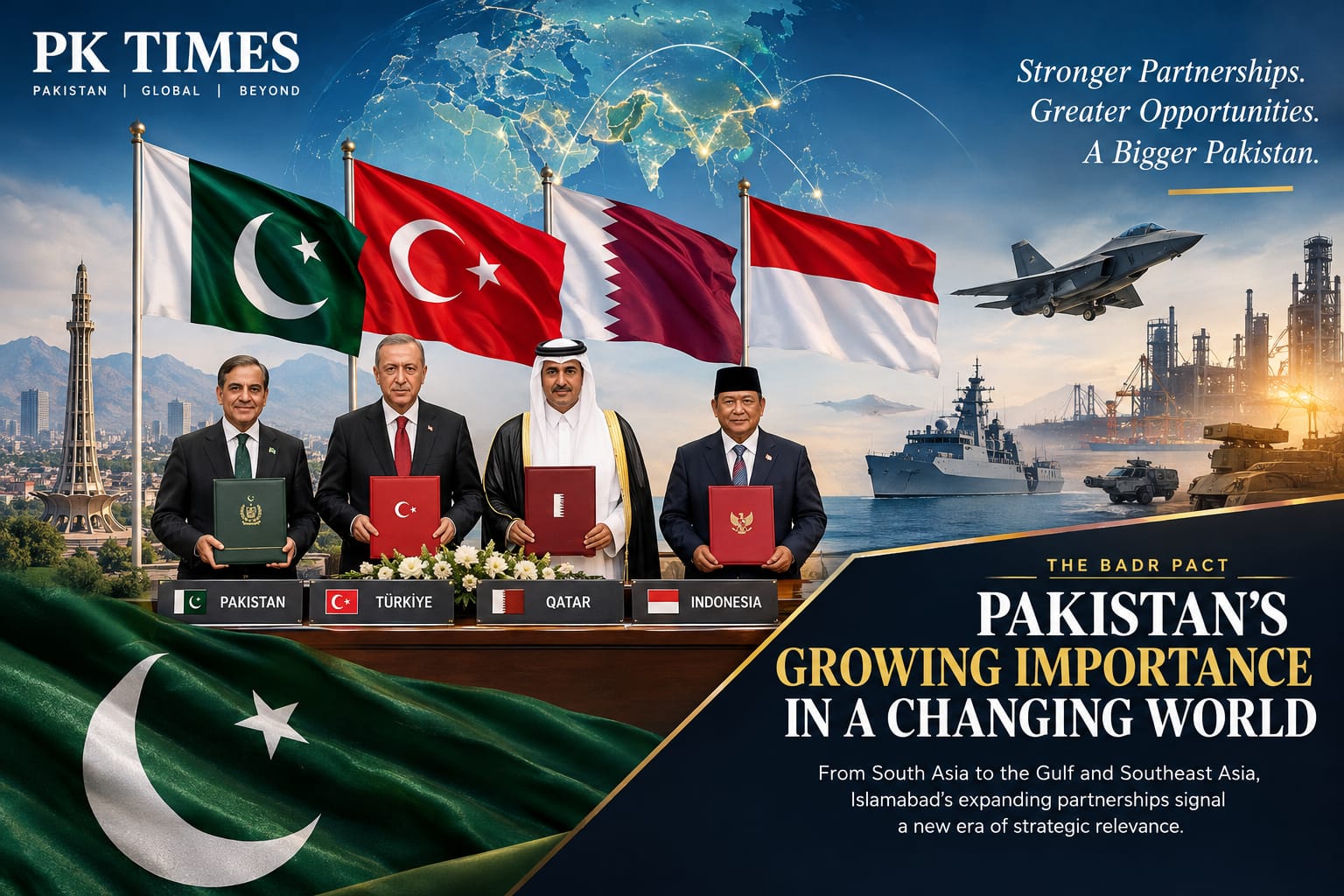
Pakistan’s strategic importance is entering a new phase as Islamabad joins Türkiye, Qatar and Indonesia in the newly signed Badr Memorandum of Understanding, an agreement that seeks to deepen defence-industrial cooperation, strengthen technical capabilities and expand collaboration in research, development and training.
Signed in Doha on October 21, the Badr agreement brings together four countries with complementary economic, industrial and strategic strengths. For Pakistan, the significance extends beyond another diplomatic understanding: it creates an opportunity to strengthen international partnerships, expand industrial cooperation and establish a more prominent role in an evolving network connecting the Gulf, South Asia and Southeast Asia.
The agreement does not establish a mutual-defence guarantee. Instead, its stated objectives centre on cooperation, production capabilities, research and development, and closer links between the participating countries’ defence industries. Its long-term importance will depend on how successfully these ambitions translate into practical projects.
For Islamabad, the message is clear: strategic relevance increasingly depends not only on geography and military strength, but also on the ability to build partnerships that deliver economic and technological benefits.
FOUR COUNTRIES, ONE STRATEGIC OPPORTUNITY
The Badr initiative brings together four countries whose capabilities could complement one another.
Türkiye has developed a substantial defence-industrial sector and is seeking to expand international cooperation. Qatar brings financial resources and an established interest in security partnerships. Indonesia offers a major Southeast Asian market and its own industrial ambitions. Pakistan contributes an established defence-production base, technical expertise and a strategic position linking South Asia with the Gulf region.
The agreement seeks to harness these complementary strengths through industrial cooperation, technical training, research and development, and enhanced production capacity. It also envisages meeting the requirements of friendly countries through greater cooperation among the participants.
For Pakistan, this creates several potential avenues for advancement.
Joint industrial ventures could create opportunities for Pakistani companies. Collaborative research could help develop domestic technical expertise. Greater cooperation with international partners could also support skills development, industrial investment and access to wider markets.
These are opportunities rather than guaranteed outcomes. Their real value will be measured by the projects launched, the expertise developed, the investment secured and the economic benefits delivered.
PAKISTAN’S GEOGRAPHY IS BECOMING A STRATEGIC ASSET
Pakistan occupies a significant position at the intersection of South Asia, Central Asia and the Arabian Sea, with connections to the wider Gulf region.
That geography has long shaped its security and foreign policy. Its importance, however, is not limited to military considerations.
Pakistan can also serve as a link between regional markets, transport networks, industrial partners and energy-producing economies. Closer cooperation with Gulf countries and Southeast Asian partners could broaden these connections and create new opportunities for trade and investment.
The Badr initiative adds an industrial dimension to this wider strategic picture.
If the participating countries develop durable commercial and technological relationships, Pakistan could strengthen its position as a partner in regional cooperation rather than being viewed solely through the lens of South Asian rivalries.
That would represent a meaningful expansion of Islamabad’s international engagement.
FROM SECURITY PARTNERSHIPS TO ECONOMIC DIPLOMACY
The Badr agreement follows another important development in Pakistan’s external relations: the Makkah Joint Defence Agreement signed by Pakistan, Saudi Arabia and Türkiye in August 2026.
The two arrangements serve different purposes.
The Makkah agreement establishes a mutual-defence framework, while Badr focuses on cooperation between defence industries, technical development and training. Together, they illustrate the expanding range of Pakistan’s partnerships with influential countries in the Gulf and beyond.
The distinction matters.
A country’s international standing is shaped not simply by the number of agreements it signs, but by the practical value of those agreements. Security cooperation can strengthen relationships between governments, while industrial partnerships can create lasting links between businesses, research institutions and technical workforces.
For Pakistan, the challenge is to make these relationships mutually beneficial.
That means pursuing investment, developing domestic capabilities, supporting exports and ensuring that international cooperation contributes to broader economic resilience.
The real strategic prize is not merely a seat at the diplomatic table. It is the ability to turn that seat into economic opportunity and sustained international influence.
THE GULF CONNECTION: BEYOND TRADITIONAL DIPLOMACY
Relations between Pakistan and Gulf countries have historically included economic, diplomatic and security cooperation.
The Badr framework offers another potential avenue for engagement by connecting Pakistan with Qatar through an initiative that also includes Türkiye and Indonesia.
For Islamabad, this could help diversify its international economic relationships and encourage cooperation beyond conventional bilateral arrangements.
For Qatar, the agreement creates a framework for collaboration with partners possessing different industrial and technical capabilities. For Türkiye, it provides another opportunity to extend industrial cooperation. For Indonesia, it offers a platform for developing relationships across a broader network of partners.
The potential benefits run in both directions.
Pakistan’s success will depend on whether it can secure meaningful participation in joint projects, attract investment, strengthen its technical workforce and ensure that domestic businesses benefit from the resulting cooperation.
Without these outcomes, the agreement risks remaining a diplomatic statement rather than becoming an instrument of economic transformation.
INDONESIA OPENS A WIDER ASIAN DIMENSION
Indonesia’s participation gives the Badr initiative a reach that extends beyond the Gulf and South Asia.
As a major Southeast Asian country, Indonesia offers Pakistan an opportunity to deepen engagement with a region whose economic importance continues to attract international attention.
The agreement could provide a platform for closer institutional relationships, industrial collaboration and exchanges of technical expertise.
It also reinforces the importance of diversified partnerships in a world where countries increasingly seek to broaden their economic and strategic options.
For Pakistan, deeper engagement with Indonesia could complement its existing relationships in the Gulf and with Türkiye, creating additional channels for diplomatic and commercial cooperation.
The broader objective should be to build relationships that remain valuable even when international circumstances change.
A CHANGING WORLD ORDER — AND PAKISTAN’S PLACE IN IT
International relations are increasingly shaped by overlapping partnerships rather than a single network of alliances.
Countries are pursuing cooperation in trade, technology, industrial development and security while seeking to preserve flexibility in their foreign policies.
The Badr agreement fits within this wider pattern. It brings together countries seeking to combine their capabilities and strengthen cooperation in a strategically important sector. Pakistan’s opportunity lies in engaging with this changing environment without unnecessarily narrowing its diplomatic options.
Its relationships with China, Gulf countries, Türkiye, Southeast Asian states and other international partners each have their own interests and limitations. Managing these relationships requires consistency, economic planning and an understanding that cooperation with one partner need not automatically come at another’s expense.
The most effective approach would be to pursue practical benefits wherever they are available while maintaining constructive diplomatic engagement across regions.
That would allow Pakistan to strengthen its international role without treating every new partnership as a contest against another country.
THE ECONOMIC TEST: CAN PAKISTAN CONVERT STRATEGIC RELEVANCE INTO PROSPERITY?
Diplomatic visibility can create opportunities, but it cannot substitute for economic performance.
Pakistan’s long-term gains from Badr will depend on whether the agreement contributes to industrial development, technical education, investment, employment and export growth.
Several questions will be particularly important.
First, will joint projects generate meaningful domestic participation? Pakistan would benefit most if cooperation strengthens local businesses and develops capabilities that can be sustained over time.
Second, will investment follow the diplomatic commitments? Agreements become economically significant when they produce funded projects, commercial partnerships and measurable results.
Third, can the partnership encourage innovation? Research collaboration and technical training could contribute to a stronger skills base, provided that knowledge is effectively transferred and applied.
Fourth, will cooperation create wider commercial opportunities? If successful, industrial collaboration could help participating countries develop products and services for markets beyond their own borders.
These questions should shape the assessment of Badr’s eventual success.
For Pakistan, the objective must be to move from diplomatic opportunity to tangible economic achievement.
THE RISKS THAT ISLAMABAD MUST MANAGE
A balanced assessment also requires recognising the limits of the new agreement.
A memorandum of understanding does not automatically guarantee investment, technology transfer or major export contracts. The participating countries must still agree on specific projects, financing, responsibilities and implementation.
Their interests will overlap in some areas and differ in others.
Pakistan will also need to balance the costs of international commitments against domestic economic priorities. Any industrial partnership must be evaluated according to its financial sustainability, commercial value and contribution to national development.
Furthermore, the Badr initiative should not be confused with a collective military alliance. Its announced focus is industrial and technical cooperation, not an automatic obligation for the four countries to support one another in a conflict. Clear expectations and practical implementation will therefore be essential.
THE BIGGER PICTURE: PAKISTAN’S RISING RELEVANCE
The significance of the Badr agreement lies in the possibility of connecting Pakistan’s existing capabilities with new international opportunities.
Its participation brings Islamabad into a four-country framework linking the Gulf, South Asia and Southeast Asia. Alongside other diplomatic and security partnerships, this creates additional channels through which Pakistan can pursue cooperation with influential regional states.
But international importance is not measured by agreements alone.
It is demonstrated through the ability to maintain trusted relationships, contribute useful capabilities, deliver reliable economic partnerships and manage disagreements through diplomacy.
Pakistan has an opportunity to strengthen its position by combining strategic engagement with domestic economic development.
That requires sustained attention to industrial competitiveness, human capital, investment and institutional capacity.
CONCLUSION: THE OPPORTUNITY IS REAL — THE OUTCOME WILL DEPEND ON EXECUTION
The Badr agreement marks a new chapter in Pakistan’s cooperation with Türkiye, Qatar and Indonesia.
It offers Islamabad a framework for pursuing industrial collaboration, strengthening technical expertise and widening its engagement with countries across two strategically important regions.
Its importance should neither be exaggerated into an alliance that does not exist nor dismissed as a purely symbolic diplomatic exercise.
The agreement creates a platform. What Pakistan builds upon it will determine its lasting value.