Riyadh’s growing economic engagement with Kabul could redraw regional trade routes, but Pakistan has more to gain than lose if Islamabad moves quickly
By Roohi Khan
ISLAMABAD: Saudi Arabia’s renewed economic engagement with Afghanistan is quietly creating a new layer in the rapidly changing economic map of the region — and Pakistan cannot afford to treat it as a development taking place on the sidelines.
The immediate development is the revival of the Afghanistan-Saudi Joint Economic Commission, with Kabul seeking to expand trade, investment, economic coordination and joint projects with Riyadh. Afghan authorities have also been working to operationalise economic commissions involving Saudi Arabia and China.
At first glance, the development appears to be primarily about Saudi investment and Afghan economic needs. But geographically and strategically, Pakistan sits directly between many of the commercial possibilities that could emerge.
The question for Islamabad is therefore not simply whether Saudi Arabia will trade more with Afghanistan.
It is whether Pakistan will become a bridge in that emerging economic relationship — or gradually be bypassed.
THE BIGGEST ISSUE: CONNECTIVITY
For decades, Pakistan’s ports have offered Afghanistan its most natural access to the Arabian Sea.
That advantage, however, can no longer be taken for granted.
Afghanistan has increasingly sought alternative routes through Iran and Central Asia. Afghan trade data for 2025 showed that businesses were already shifting towards routes through Chabahar and Central Asian countries amid repeated disruptions on the Pakistan-Afghanistan border.
That is the warning signal for Islamabad.
If Saudi capital begins flowing more substantially into Afghanistan, investors will look for the cheapest, safest and most predictable routes to move goods.
Pakistan has an enormous geographical advantage — but geography alone is not enough.
Infrastructure, border stability, customs efficiency and political predictability will determine whether Pakistan captures the business.
WHAT PAKISTAN CAN GAIN
The first and potentially biggest benefit is transit trade.
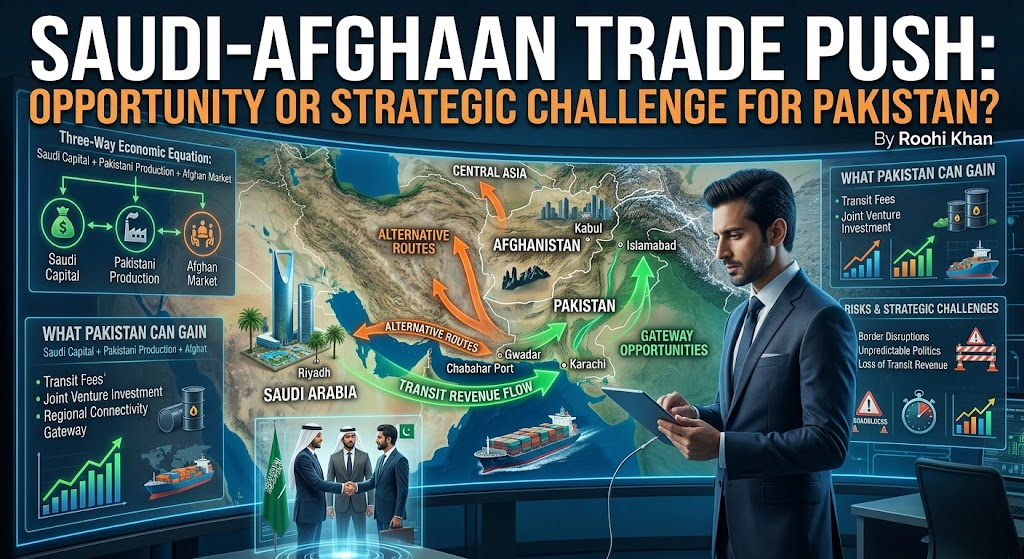
If Saudi companies invest in Afghan agriculture, mining, food processing, logistics or infrastructure, Pakistan could position Karachi and Gwadar as gateways for Afghan-Saudi commerce.
That would mean revenues not only from port activity but also from trucking, warehousing, insurance, banking, customs and logistics.
Pakistan could effectively earn from trade between two other countries.
There is another opportunity.
Saudi Arabia already views Pakistan as a potential production partner and regional market gateway. Islamabad and Riyadh have been working on expanding trade and investment, with particular attention to agriculture, food products and regional markets.
This creates the possibility of a three-way economic equation:
Saudi capital + Pakistani production + Afghan market and resources.
Pakistan could supply food, pharmaceuticals, textiles, construction materials, engineering products and other goods to Afghanistan while Saudi investors provide capital and access to larger markets.
That would be considerably more valuable than simply earning transit fees.
THE CENTRAL ASIAN ANGLE
The Saudi-Afghan economic relationship could also accelerate a broader regional trend: the linking of the Gulf with Central Asia.
Pakistan’s strategic objective should be to position itself as the southern commercial gateway for Central Asia.
The country’s ports are geographically positioned to provide Central Asian economies with access to the Arabian Sea.
But Afghanistan is the crucial land bridge.
If Pakistan can maintain efficient commercial relations with Kabul, Saudi investors could eventually find it commercially attractive to route some Gulf-Central Asian trade through Pakistani territory.
That would transform Pakistan’s geographical position into an economic asset.
Islamabad and Riyadh have already identified Central Asia, Africa and ASEAN as potential areas for expanding cooperation and regional market engagement.
The Afghan-Saudi initiative therefore need not be viewed as competition.
It can become another piece of Pakistan’s regional connectivity strategy.
BUT THERE IS A REAL RISK
There is also a downside.
Afghanistan is deliberately diversifying its trade routes.
If the Pakistani route remains unreliable because of border closures, diplomatic disputes or security concerns, Saudi and other international investors may simply build their business models around alternative corridors.
That would gradually weaken Pakistan’s traditional position as Afghanistan’s preferred gateway.
The consequences could extend beyond transit revenues.
Pakistani exporters have historically benefited from proximity to the Afghan market. But Afghanistan’s search for alternative suppliers and routes could gradually reduce that dependence.
The trend is already visible: Afghan trade survived repeated disruptions with Pakistan in 2025 by shifting toward Iran and Central Asia.
For Islamabad, this should be treated as a strategic economic warning rather than merely a diplomatic dispute.
PAKISTAN’S OTHER ADVANTAGE: SAUDI RELATIONS
There is, however, one major factor working in Pakistan’s favour — the depth of its relationship with Saudi Arabia.
Islamabad and Riyadh launched an Economic Cooperation Framework in October 2025 aimed at expanding trade and investment relations.
That gives Pakistan an opportunity that other regional competitors do not necessarily possess.
Instead of seeing Saudi economic engagement with Kabul as a zero-sum development, Islamabad can propose a complementary model:
Riyadh invests in Afghanistan; Pakistan provides production capacity, logistics, ports and regional connectivity.
Such an arrangement could turn Pakistan from a potential loser into an indispensable economic intermediary.
WHAT COULD PAKISTAN LOSE?
Three risks stand out.
First, transit revenue. If Afghanistan succeeds in permanently shifting substantial trade toward Chabahar and Central Asian corridors, Pakistan could lose a portion of its traditional transit business.
Second, market share. Afghan traders increasingly have alternatives for sourcing goods, particularly from Iran, China, Central Asia and the Gulf.
Third, strategic leverage. Economic dependence creates diplomatic influence. The less Afghanistan depends upon Pakistan for trade and access to the sea, the less economic leverage Islamabad possesses over Kabul.
This matters because Pakistan’s relationship with Afghanistan remains heavily influenced by security tensions, including the continuing dispute over militant activity and the border. Recent clashes and accusations over cross-border militancy have further complicated bilateral relations.
THE SMART PAKISTANI RESPONSE
Pakistan should not attempt to block Saudi-Afghan economic engagement.
That would be strategically counterproductive.
Instead, Islamabad should attempt to insert itself into the equation.
The objective should be to make Pakistani territory the most commercially attractive corridor connecting the Gulf, Afghanistan and Central Asia.
That requires four things:
Reliable borders.
Competitive transit costs.
Faster customs procedures.
Long-term commercial guarantees for investors.
Pakistan should also actively encourage Saudi companies to invest in Pakistani logistics, agriculture, food processing and industrial capacity linked to Afghan and Central Asian markets.
The opportunity is particularly important because Saudi Arabia is already looking at expanding agricultural and food trade cooperation with Pakistan.
THE BIGGER GEOPOLITICAL PICTURE
The Saudi-Afghan economic opening should be viewed as part of a much larger regional transformation.
Afghanistan is attempting to reduce its economic dependence on any single neighbour.
Saudi Arabia is expanding its economic and diplomatic footprint beyond the Gulf.
China remains deeply interested in Afghanistan and Central Asia.
Iran is promoting Chabahar as an alternative gateway.
Central Asian states are looking southward for access to international markets.
And Pakistan is attempting to establish itself as a connectivity hub linking Central Asia with the Arabian Sea.
The competition is therefore not simply about who sells what to Afghanistan.
It is about who controls the routes through which the next generation of regional commerce will move.
VERDICT: MORE OPPORTUNITY THAN THREAT
For Pakistan, the Saudi-Afghanistan economic opening is not inherently a loss.
In fact, handled intelligently, it could become an opportunity.
Pakistan possesses something Afghanistan cannot manufacture and Saudi Arabia cannot relocate: geographical proximity to the Arabian Sea combined with an existing commercial relationship with both countries.
But that advantage can disappear if Islamabad allows political disputes to repeatedly disrupt commerce.
The strategic choice is now straightforward.
Pakistan can view Saudi investment in Afghanistan as competition and watch alternative trade corridors grow.
Or it can position itself as the economic bridge between Riyadh, Kabul and Central Asia.
The second option offers Pakistan far greater dividends.
The Saudi-Afghan economic opening, therefore, should not be read as a Saudi move away from Pakistan.
It should be read as a test of whether Pakistan is capable of turning geography into economic power.