By M. Abubakar
A Historic Lens on the Sindh Administrative Debate
As discussions around new provinces and administrative divisions gain momentum across Pakistan, references frequently turn to the complex history of Sindh. Understanding this trajectory offers crucial context for today’s political debates.
In 1591–1592, Mughal Emperor Akbar defeated Mirza Jani Beg Tarkhan, bringing much of present-day Sindh, parts of Balochistan, and southern Punjab under Mughal realm. The empire often governed through local chiefs, appointed governors, and tributary rulers. In Upper Sindh, the Daudpotras initially served as military governors. However, the Kalhoro tribe—leveraging a significant Sufi following turned militia—clashed with the Daudpotras. By 1701, the Mughals recognized Mian Yar Mohammad Kalhoro as the ruler of Upper Sindh under their suzerainty, granting him administrative control (ijara).
His successor, Mian Noor Mohammad Kalhoro, expanded his rule into central and lower Sindh. By 1736, the Mughals recognized the Kalhoro dynasty as rulers of the entire province down to Thatta. This marked the first time an indigenous Sindhi family ruled most of present-day Sindh. While the Samma Rajputs and Soomras had ruled earlier, key eastern, northeastern, and southern territories—including Karachi—were missing. The Kalhoro era was also a golden age for culture, during which Shah Abdul Latif Bhittai composed Shah Jo Risalo.
Following the Battle of Halani in 1783, the Talpur tribe overthrew the Kalhoros. The Talpurs eventually split into three distinct ruling houses:
- Shahdadpur Branch: Ruled Lower Sindh from Hyderabad (founded by Mir Fateh Ali Talpur).
- Manikani Branch: Ruled Eastern Sindh, including Mirpurkhas and parts of Thar (founded by Mir Tharo Khan).
- Sohrabani Branch: Ruled Upper Sindh from Khairpur (founded by Mir Sohrab Khan).
The Evolution of Karachi’s Governance
Karachi’s status shifted repeatedly over the centuries:
- Pre-1729: A small fishing village of Baloch and Katchi communities.
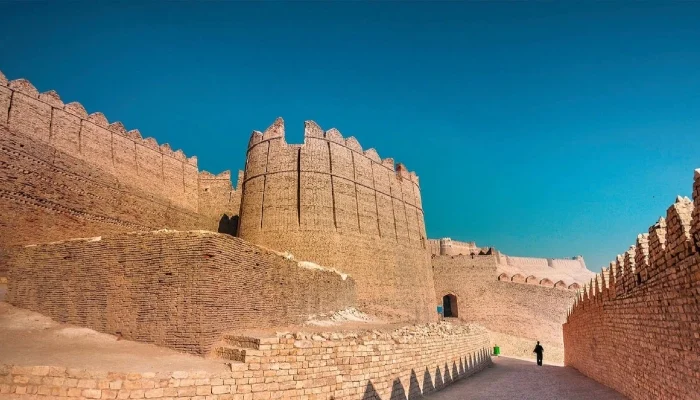
- 1729–1745: After a nearby port silted up, a merchant consortium led by Bhojo Mal established a port city in Karachi’s natural harbor, paying duties to the Kalhoros and fortifying the city with the famous Methadar and Kharadar gates.
- 1745–1795: Following battles between the Kalhoros and the Khanate of Kalat, the Kalhoros ceded Karachi to the Khan of Kalat as compensation for the death of Mir Abdullah Khan.
- 1795: The Shahdadpur Talpurs captured Karachi from the merchants operating under Kalat’s protection.
- 1839–1843: The British captured Karachi from the Shahdadpur Talpurs in 1839, expanding its port infrastructure until it was shipping more wheat than Bombay by 1890. After defeating the Hyderabad and Mirpurkhas Talpurs in 1843, the British annexed most of Sindh. However, they spared the Sohrabani branch in Khairpur for aiding them, allowing the princely state of Khairpur to survive until 1955.
Modern Administrative Realities
When Sindh separated from the Bombay Presidency in 1936, Karachi was part of the province, but Khairpur was not. In fact, the only time Karachi came under the administration of a fully unified Sindh was in 1970, when General Yahya Khan dissolved One-Unit.
At Partition, when Karachi was designated as the federal capital, Sindh Chief Minister Ayub Khuhro strongly objected. The central government overruled him, promising financial compensation. Sindh demanded Rs60 crore, and a commission recommended Rs30 crore, but by 1953 only Rs2 crore had been paid. Political maneuvering around One-Unit continued for years, leading to frequent dismissals and reappointments of provincial leaders like Khuhro and Pirzada Abdul Sattar.
Today, political parties in Sindh, Punjab, and Khyber Pakhtunkhwa largely defend the status quo ante, retaining centralized power with the chief ministers rather than pursuing meaningful devolution. However, dynamic differences persist: while political majorities in KP and Punjab show openness to administrative realignments in areas like Hazara or southern Punjab, the ruling coalition in Sindh remains strongly committed to keeping Karachi under provincial control.
Given this intricate history, the ongoing debate over administrative boundaries will undoubtedly bring further political developments in the months ahead.