Jailed JKLF leader seeks capital punishment while denying Sarla Bhat killing, raising questions over India’s Kashmir narrative and the future of the freedom struggle
By Roohi Khan
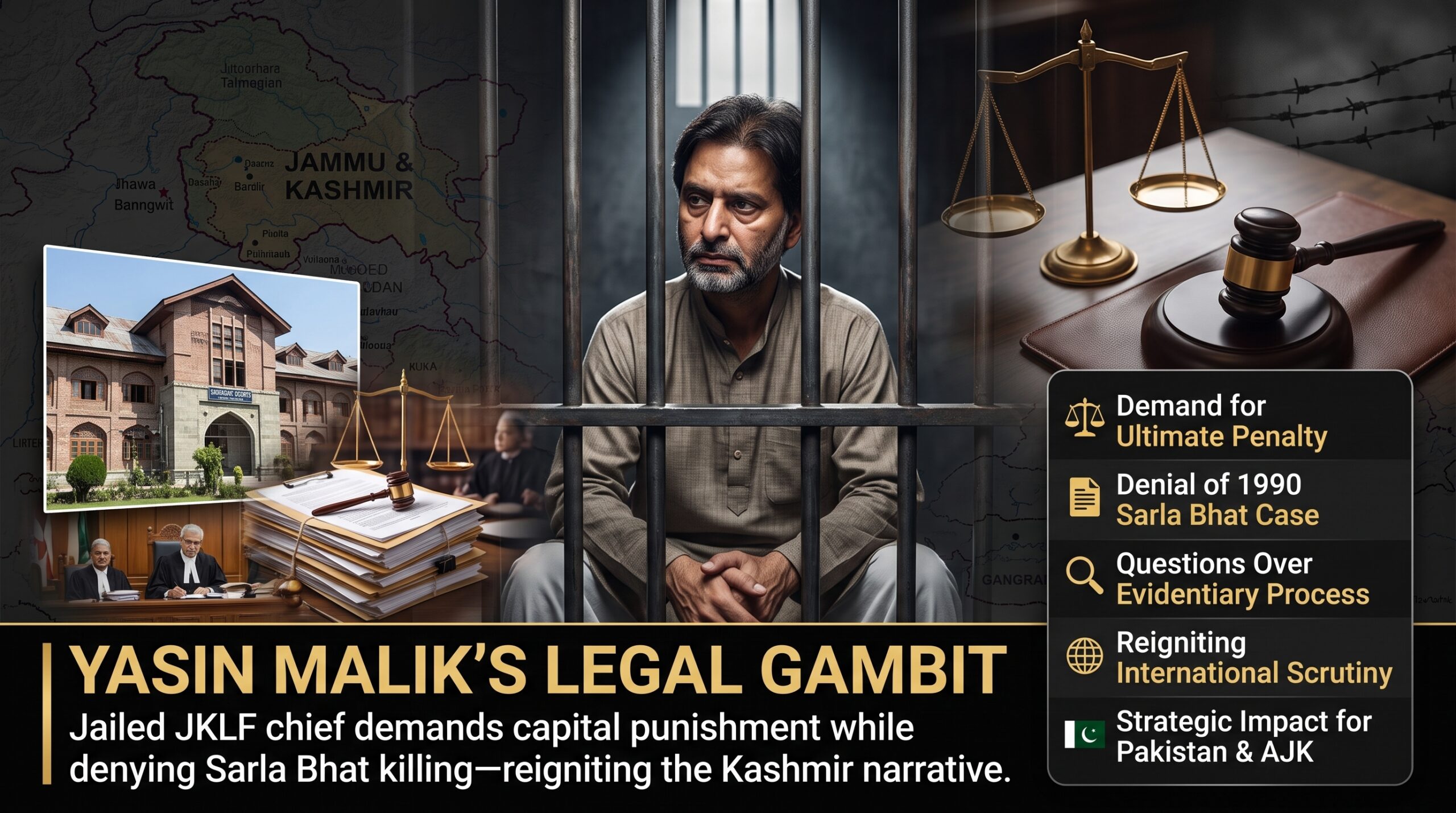
ISLAMABAD: In a dramatic development that could reverberate far beyond the courtroom, jailed Jammu Kashmir Liberation Front (JKLF) chief Yasin Malik has asked an Indian court to award him capital punishment while simultaneously maintaining that he had no role in the 1990 killing of Kashmiri Pandit nurse Sarla Bhat.
Malik’s extraordinary position — refusing to contest the proceedings while insisting that his decision is not an admission of guilt — has injected a new and deeply political dimension into the decades-old Kashmir conflict. His 25-page submission has also questioned the evidence and the circumstances in which he was implicated decades after the killing.
The Srinagar court is due to consider the prosecution’s response on September 19, 2026.
A courtroom drama with consequences for Kashmir
For Pakistan, the significance of the development extends beyond the fate of one imprisoned separatist leader.
Malik has for years been one of the most recognisable faces of the Kashmiri separatist movement. His latest statement therefore risks becoming another major flashpoint in the battle over how Kashmir’s history, politics and resistance are interpreted.
His position is strikingly contradictory on its face: he rejects responsibility for Sarla Bhat’s killing, calls himself falsely implicated, questions the prosecution’s case — yet asks the court to impose the ultimate punishment on him.
That contradiction makes the legal process itself critically important.
Pakistan’s strongest position is not to prejudge the verdict, but to demand that any proceedings involving such a consequential Kashmir figure meet the highest standards of due process, transparency and evidence.
According to reports on his affidavit, he questioned why such material had not resulted in his being named in the original investigation.
Those claims remain Malik’s allegations,
WHAT IT MEANS FOR PAKISTAN AND AJK
For Pakistan and Azad Jammu and Kashmir, Malik’s latest move could have three major consequences.
First, it could reignite international attention on Kashmir.
A case involving a prominent Kashmiri separatist, a decades-old killing and a disputed evidentiary record has the potential to reopen debate over the unresolved political dimensions of Kashmir.
Second, it puts Pakistan’s diplomatic messaging under a sharper spotlight.
Islamabad can use the development to reinforce its long-standing argument that Kashmir cannot be addressed purely through security and judicial measures. The political aspirations of Kashmiris remain central to the dispute.
Third, it may reshape the symbolism surrounding Malik himself.
Whatever ultimately happens in court, his decision to reject further contesting the proceedings has transformed the case from another long-running legal battle into a powerful political symbol for supporters of Kashmiri self-determination.
THE BIGGER BATTLE IS THE NARRATIVE
The danger for Pakistan would be to allow the episode to become merely a contest over whether Malik is guilty or innocent.
The bigger issue is the Kashmir question itself.
Pakistan’s strongest argument internationally is that the suffering and political aspirations of Kashmiris cannot disappear from the agenda simply because one prominent separatist leader is behind bars.
At the same time, any serious Pakistani position must acknowledge the suffering of all Kashmiri communities, including Kashmiri Pandits and Muslims, and insist that allegations of violence be investigated through credible legal mechanisms.
That approach gives Pakistan a stronger diplomatic position: support the political rights of Kashmiris without compromising the principle of justice for victims.
A MOMENT FOR ISLAMABAD TO THINK BEYOND HEADLINES
Yasin Malik’s extraordinary demand may dominate headlines for days. But Pakistan’s response should look beyond the immediate drama.
The real strategic question is whether the episode can bring renewed international scrutiny to the unresolved Kashmir dispute — and whether Islamabad can turn that attention into a coherent diplomatic campaign centred on human rights, political representation and the right of Kashmiris to determine their future.
For AJK, the message is equally significant: Kashmir’s future cannot be defined by one man’s courtroom decision.
Malik’s fate belongs to the courts.
Kashmir’s political future remains a much bigger question.