By M. Abubakar
Published September 09, 2026
Iran issued explicit threats of “economic warfare” to the United States while revealing the deployment of an advanced ballistic missile against US warships, signaling an escalating trajectory in the six-month conflict.
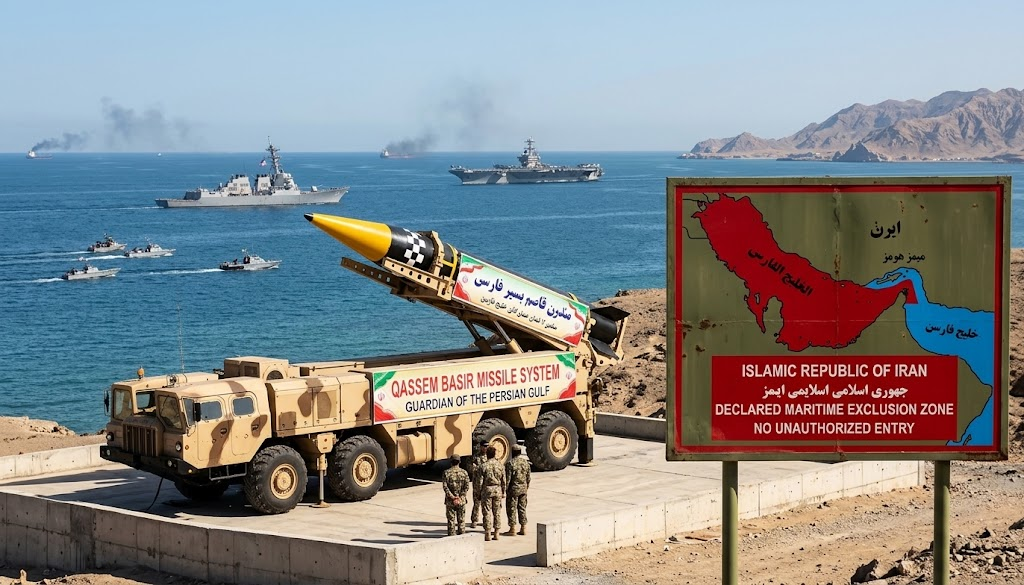
The war has seen a pattern of periodic flare-ups following quiet intervals. After US forces launched strikes against three Iranian oil tankers, Iranian state media confirmed the deployment of its new Qassem Basir missile toward US naval assets operating near the Strait of Hormuz. Though the US military stated its warships successfully evaded the attacks, the operational posture in the region remains highly volatile.
Planned Maritime Restricted Zone
Tehran announced plans to establish a formal restricted zone across the Persian Gulf alongside defined transit corridors through the Strait of Hormuz. According to Mohsen Rezaei, Secretary of Iran’s Supreme National Security Council, the proposed zone will span from the perimeter of the US blockade deeper into Gulf waters. Any commercial or military vessels entering the restricted territory without authorization face placement on an Iranian sanctions list.
Rezaei reiterated the strategy on X:
“In recent days, Washington has received a clear warning from Iran’s new missiles. Economic warfare will be met by a maritime exclusion zone across the Persian Gulf to the blockade perimeter. The operational posture toward US warships and bases has been fundamentally recalibrated.”
Capabilities of the Qassem Basir Missile
Iran claims the Qassem Basir represents a significant technical upgrade over previous systems:
- Enhanced Maneuverability: Designed specifically to bypass modern integrated missile defense systems.
- Electronic Warfare Resistance: Features guidance systems built to maintain targeting accuracy under heavy electronic countermeasures.
- Combat History: First deployed in combat operations against Israel in June 2025.
Despite extensive US strikes aimed at crippling Iran’s conventional military capabilities, Tehran continues to leverage drone and missile arsenals to disrupt maritime traffic. Shipping data indicates that traffic through the Strait of Hormuz has plummeted to an average of just 10 commodity vessels per day—the lowest figure recorded since May.
Geopolitical and Economic Fallout
The continued maritime disruptions come as the conflict draws closer to the upcoming US congressional elections. Addressing the rising energy prices caused by the shipping chokehold, US President Donald Trump commented on social media that oil prices would drop significantly once the military objectives of “Operation Epic Fury” are met.
Concurrently, regional instability has widened. Recent Israeli strikes in southern Lebanon killed at least 12 people, threatening a fragile June ceasefire with Hezbollah. Tehran maintains that any permanent diplomatic resolution with Washington remains contingent on a complete cessation of Israeli military actions in Lebanon.