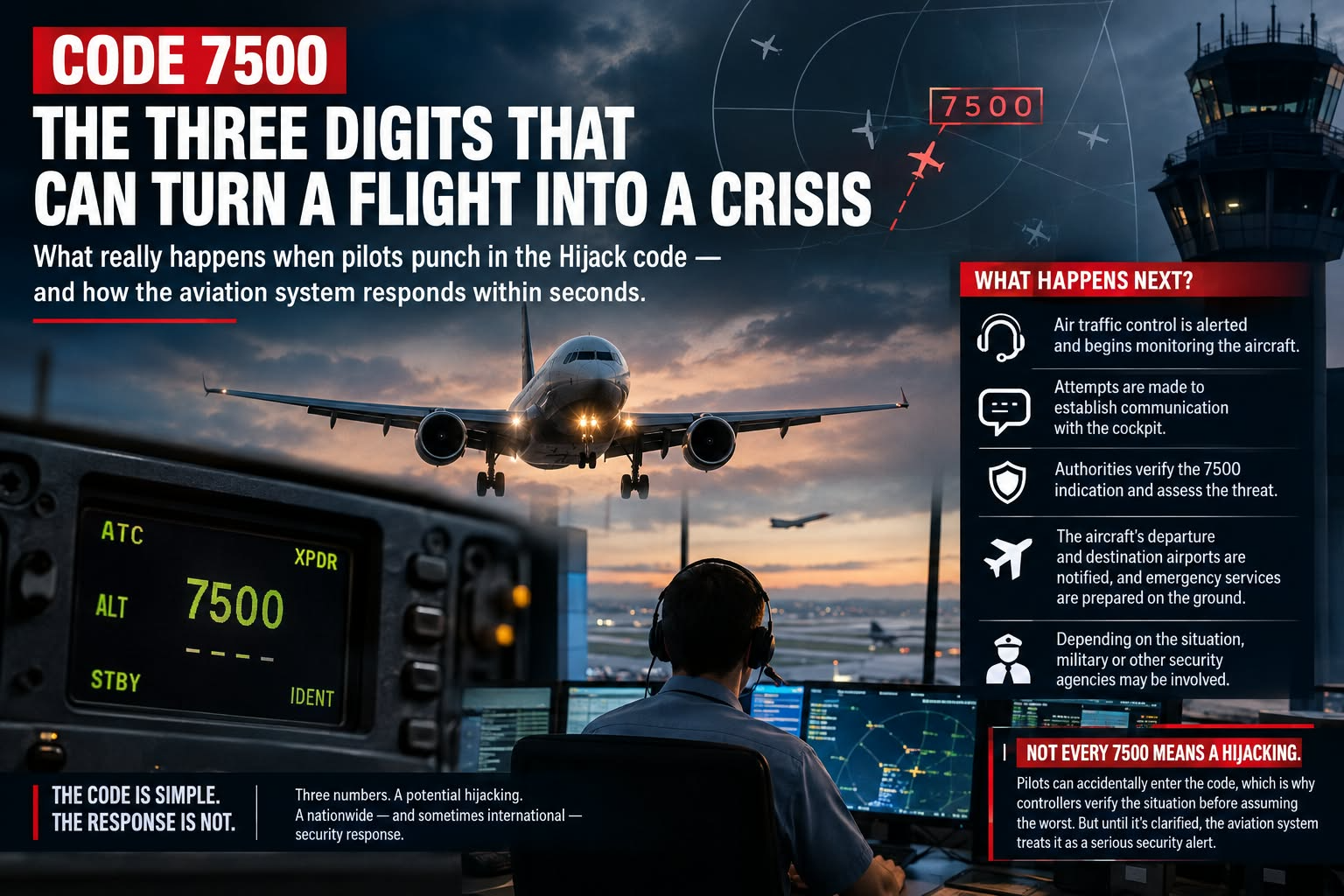
What really happens when pilots punch in the hijack code — and how the aviation system responds within seconds
By Roohi Khan
Three numbers can instantly transform the atmosphere aboard an airliner and trigger one of the most serious emergency responses in commercial aviation.
7500.
For most passengers, the code means nothing. Inside aviation, however, it carries a chilling message: the aircraft is indicating a possible unlawful interference or hijacking.
The recent two Avi flights incident has once again put the spotlight on what happens when that code appears on an aircraft’s transponder and how authorities distinguish a genuine security emergency from an accidental activation.
THE SILENT SIGNAL
Unlike an ordinary emergency call, a 7500 transmission can be deliberately discreet.
A pilot can enter 7500 into the aircraft’s transponder, allowing air traffic controllers and surveillance systems to recognise the aircraft’s status without necessarily broadcasting an alarming announcement to passengers.
That distinction is crucial.
A pilot facing a security threat may not want to openly announce what is happening inside the cockpit. The transponder therefore becomes a potential lifeline — a silent digital message travelling through the aviation network.
WHAT HAPPENS NEXT?
The moment controllers identify a genuine 7500 indication, the aircraft can be treated as a potential hijacking or unlawful-interference situation.
Air traffic control begins coordinating with relevant aviation-security and government authorities. The response can involve:
continuous monitoring of the aircraft;
attempts to establish communication with the cockpit;
verification of the 7500 indication;
coordination with the aircraft’s destination and departure airports;
preparation of emergency services on the ground;
and, depending on the circumstances, military or other security authorities.
The precise response varies according to the country, airspace and circumstances.
But one principle remains constant: a 7500 signal is not treated casually.
NOT EVERY 7500 MEANS A HIJACKING
There is an important complication.
Pilots can accidentally select 7500. That is why controllers are trained to verify the situation rather than immediately assuming that an aircraft has been seized.
If the crew is able to communicate normally, controllers may ask questions designed to establish whether the code was entered intentionally.
A mistaken code can therefore be cancelled or corrected.
But until the situation is clarified, authorities have to take the possibility of a genuine security threat seriously.
WHY THE CODE MATTERS
The importance of 7500 lies in its simplicity.
Modern aircraft are connected to an enormous chain of systems involving pilots, controllers, airports, security agencies and emergency responders. A three-digit transponder code can therefore become the first trigger in a much larger security response.
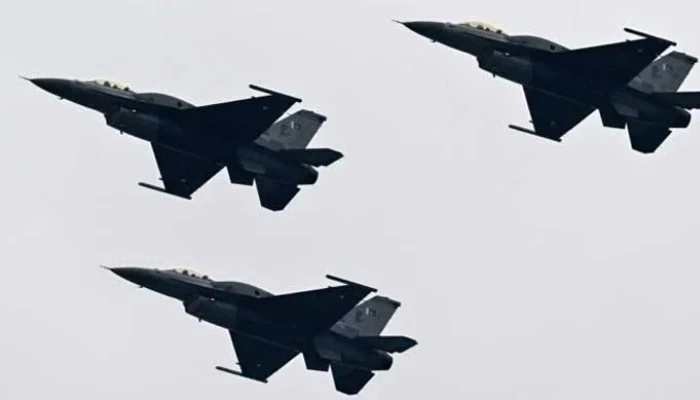
It is not a magic button that automatically sends fighter jets into the sky.
Nor does it mean that passengers are necessarily in immediate danger.
It means something much more specific:
the cockpit is signalling that unlawful interference may be taking place.
THE PASSENGERS MAY KNOW NOTHING
Perhaps the most striking aspect of a 7500 situation is what passengers may experience — or fail to experience.
There may be no dramatic announcement.
The aircraft may continue flying normally.
Cabin crew may continue serving passengers.
The pilots may maintain their routine communication with air traffic control while security procedures are activated behind the scenes.
That is deliberate.
In a genuine hijacking scenario, maintaining calm can be an important part of the response.
THE AVIV INCIDENT SPOTLIGHT
The two Avi flight incidents have renewed attention on the significance of emergency transponder codes and the delicate balance between rapid response and verification.
Aviation authorities cannot afford to ignore a 7500 indication. At the same time, every unusual signal cannot automatically be treated as proof of a hijacking.
That is why the system relies on layers of confirmation — cockpit communications, aircraft behaviour, air-traffic-control procedures and information from security authorities.
THREE NUMBERS. A HUGE RESPONSE.
The public usually hears about aviation emergencies only after an aircraft lands, an investigation begins or authorities release details.
Inside the system, however, the response can begin much earlier.
A simple change on a transponder display can alert controllers that something potentially extraordinary is happening thousands of feet above the ground.
7500 is therefore less a declaration of what has happened than an urgent signal that something may be seriously wrong.
And when those three numbers appear, the aviation system listens.